Zoya Mateen and Azadeh MoshiriBBC News

 Saurabh Luthra/Instagram
Days after a devastating fire at an upscale nightclub in India’s Goa state killed 25 people, the spotlight remains on the two brothers who co-owned the place.
On Tuesday, Saurabh and Gaurav Luthra were deported to India from Thailand, where they fled hours after the incident on 7 December.
A third partner in the nightclub, Ajay Gupta, was detained in Delhi last week.
Until a few weeks ago, the brothers who grew up in Delhi, were not known beyond India’s hospitality and nightlife circuit.
Those who knew them describe a life rooted in ordinary beginnings: a paralysed father who once ran a flourishing business, a religious mother loved by her community, and two sons who represented a new generation of Indian restaurateurs – ambitious, social-media savvy and eager to scale their brand across cities.
“They were Delhi boys in the broadest sense,” a city-based musician who knows the brothers told the BBC on the condition of anonymity, referring to the traits of brashness and risk-taking often associated with the Indian capital’s social and business culture. “Well-networked and ambitious, they used the city and their connections to build visibility.”
But hours after the deadly fire, the brothers boarded a plane to Phuket and left the country, sparking outrage and intense scrutiny. Police launched an investigation and Interpol issued notices against them. Overnight, the budding entrepreneurs had turned into international fugitives.
Once back, the brothers will be investigated on charges of culpable homicide among other allegations. They deny any wrongdoing and say they “never intended to evade” the law, alleging that they were being “erroneously portrayed” as villains in a wider tragedy.
How did they get here?
 Anadolu via Getty Images
Born into a middle-class family in northern Delhi, the brothers grew up far from the dizzying glamour associated with the venues they would eventually own.
To their neighbours, they were simply Saurabh and Gaurav – the polite sons of a friendly couple. “They were deeply religious, especially the mother,” a neighbour told the Times of India newspaper, with another resident adding that the family’s conduct was “was always very good”.
Their father, largely bedridden after a paralytic attack, shaped the rhythm of the house – after his illness, the family opened a boutique clothing store in the neighbourhood to revive their incomes, while the brothers focused on their education.
Saurabh studied engineering from a university in Gujarat state. On the club’s official website, he is described as a “gold medalist engineer turned into a promising and fastest-growing restaurateur”. In comparison, Gaurav’s personal life is less documented, but reports suggest he also had a degree in engineering.
Their entrepreneurial journey began with a cafe in 2016 in Hudson Lane – a vibrant students’ hub near the Delhi university – which swiftly became a favourite among the young crowds. Buoyed by its success, the brothers launched another casual diner, called Dramebaaz, in the same neighbourhood shortly after.
But the real breakthrough came a few years later with Romeo Lane, an upscale nightclub. The venue leaned on a recognisable aesthetic of balancing carefree indulgence with planned spectacle: sleek finishings, handcrafted cocktails, loud Bollywood music, and themed events.
 AFP via Getty Images
Its success inspired expansion and in no time, dozens of outlets sprang up across the country, including in smaller cities such as Noida, Meerut, Lucknow and Dehradun. They also opened a property in Dubai last year.
“These were loud, flamboyant spaces with belly dance performances and lots of Bollywood nights,” the Delhi-based musician said.
“Compared to other places, Romeo Lane was also a lot more affordable, giving the wider masses, especially the urban youth, their first glimpse of nightlife,” he added.
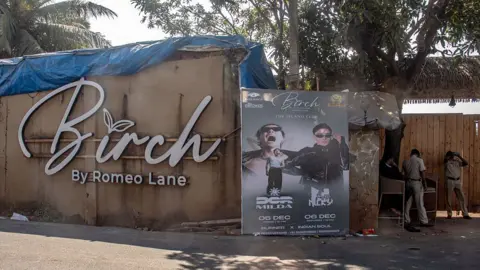
Opened in 2024, Birch by Romeo Lane – the site of the fire in Goa – was meant to be an extension of this formula but on a grander scale, a luxuriant tropical island that offered an escape from the din of city life.
“It was a sprawling venue with vast open spaces, ponds and fresh air. That a fire broke out at such a venue is beyond belief,” a resident from Bengaluru city, who visited the place last year, told the BBC.
As the brothers’ business grew, Saurabh took on a more public-facing role, driving strategy as the chairman.
His Instagram account, which is still public, reads like a carefully curated digital diary of a hospitality impresario: You see pictures of ribbon-cutting ceremonies at new openings, group snaps with chefs standing beneath freshly lit signage and the occasional photo with a celebrity, charting his rise as a successful entrepreneur for his 14,000 followers.
Two years ago, he was listed in Economic Times newspaper’s “40 under 40” list. Last month, he was also featured on Forbes India – the company account for Romeo Lane shared the article on Instagram, which described him as a leader focused on building a “legacy”.
His brother Gaurav, on the other hand, has a quieter presence online. His Instagram account is sparse, strictly devoted to posts about the venues.
Reports say he was more involved in the day-to-day operations, looking after their finances and management. “But the brand they projected was unified: the Luthra brothers,” the musician said.
 Saurabh Luthra/Instagram
Their rapid rise, however, was not without controversy, especially in Goa where their venues faced complaints about permits and safety compliances.
In 2024, police launched an investigation against the property for allegedly playing loud music, which was way above the permissible limits, after a few residents filed a complaint. The case, of which the BBC has seen a copy, is ongoing.
Before that in 2023, a resident filed a complaint with local authorities against the venue, alleging that it was illegally constructed in an ecologically sensitive zone.
The BBC has a copy of the complaint, which also alleged that the venue was discharging untreated sewage “directly into the ecologically sensitive Baga river, which ultimately connects to the Arabian Sea, causing substantial environmental pollution”. The complaint does not mention the brothers directly but refers to their local business partner.
However, in November, the Goa Coastal Zone Management Authority closed the case, concluding that the structures housing the nightclub were legal and fell outside the legally protected coastal areas.
Then earlier in May, Goa’s Tourism Department issued orders to demolish parts of Romeo Lane in Vagator – a second property owned by the brothers – for encroaching on public beach land.
Action was taken only this month, when a portion of the structure was demolished under orders from the chief minister days after the deadly blaze.
But unlike in Delhi, where they led an outwardly public life, the brothers were virtually unknown in Goa, says Tahir Noronha, a local architect, who has been at the forefront of protests against the Romeo Lane properties.
“They were like ghosts. Even during court proceedings, they would send a manager to represent them, never showing up themselves,” he said.
In court filings, the brothers have argued that they were “licensees, not operators” of the venue and had no direct control over the day-to-day safety regulations of the club. The BBC has reached out to Romeo Lane for comment.
As investigators piece together the events that led to the fire, the story of the brothers continues to unfold – on TV, newspapers and mobile apps.
The Luthra brothers have become household names, but not for the reasons they had hoped.
Related Posts

UK government will buy tech to boost AI sector in $130M growth push
“Our particular strengths as a country lie in areas like…

‘Dreadful’ first half dooms Barcelona in 4-1 thrashing by Sevilla
Midfielder Pedri slammed a "dreadful" first half as Barcelona suffered…

North Korea, Laos agree to boost ‘bonds of friendship’ after high-level talks
[ad_1] The foreign ministers of North Korea and Laos agreed…