
 AFP via Getty Images
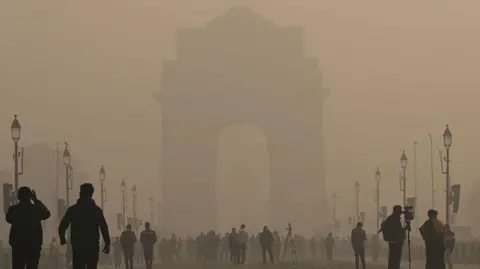
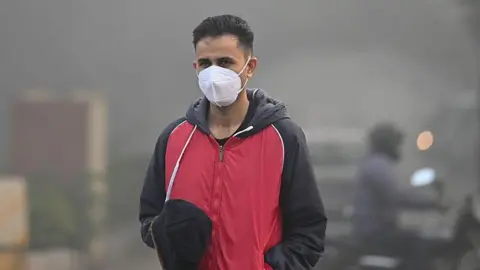
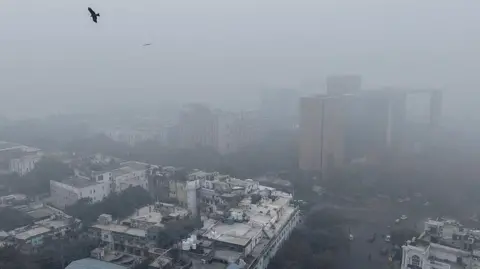
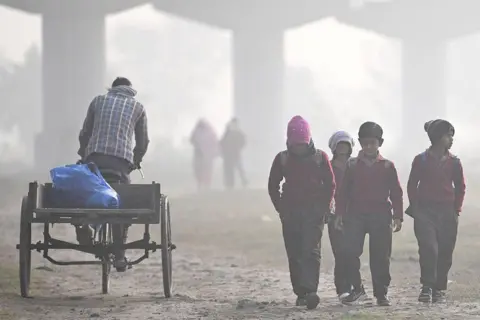
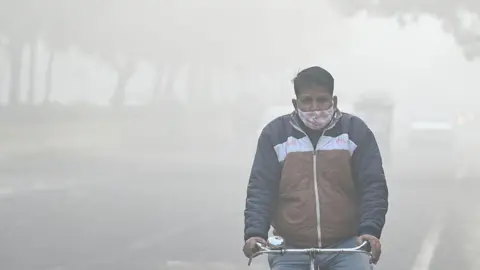
The air quality in India’s capital Delhi and adjoining regions continues to be hazardous for several days now, even as a layer of haze engulfs the city.
On Thursday morning, the city’s overall air quality index – which measures PM2.5, fine particulate matters that can clog lungs, and other pollutants – was recorded at 376, which is more than 25 times the limit recommended by the World Health Organization.
Exposure to this level of pollution can cause serious health problems, especially in children and elderly people.
 Getty Images
 Getty Images
On Wednesday, Delhi government made it mandatory for all government and private institutions to switch to “work from home” for 50% of their employees.
Several other pollution-control measures have also kicked in – such as a ban on old diesel vehicles on Delhi’s roads and construction activities, hybrid classes in schools and no-entry for older vehicles not adhering to fuel efficiency and pollution control standards.
 AFP via Getty Images
 AFP via Getty Images
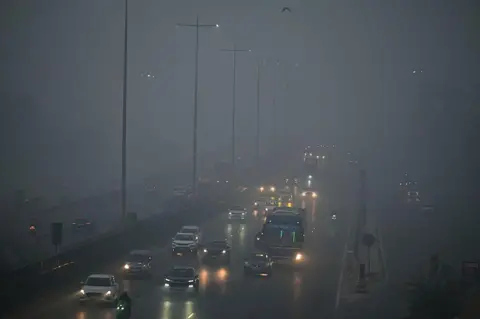
Toxic air is a recurring problem in Delhi and its neighbouring regions in northern India, especially during winters.
The problem is attributed to a mix of factors such as industrial emissions, vehicle exhaust, dropping temperatures, low wind speeds and the seasonal burning of crop stubble in neighbouring states.
 Hindustan Times via Getty Images
 AFP via Getty Images
 Getty Images
Related Posts

In ‘watershed moment’, Tesla board to vote on Musk’s $1 trillion package | Elon Musk News
[ad_1] Tesla’s board is set to vote on CEO Elon…

Seoul cannot ‘readily agree’ to expand mission of US troops on peninsula: Lee
[ad_1] South Korea cannot “readily agree to” expanding the mission…

The Mysterious Math Behind the Brazilian Butt Lift
In the history of gluteal enhancement, Mexico City stands out.…