Ben Chu and Anthony ReubenBBC Verify
 BBC
BBCIn December 2024, Prime Minister Keir Starmer outlined his government’s “plan for change” and set targets in key areas, including house building, hospital waiting lists and living standards.
He called them “measurable milestones” that would “track our progress and allow the British people to hold us to account”.
BBC Verify looks at how the government is getting on with these pledges one year on.
Building houses
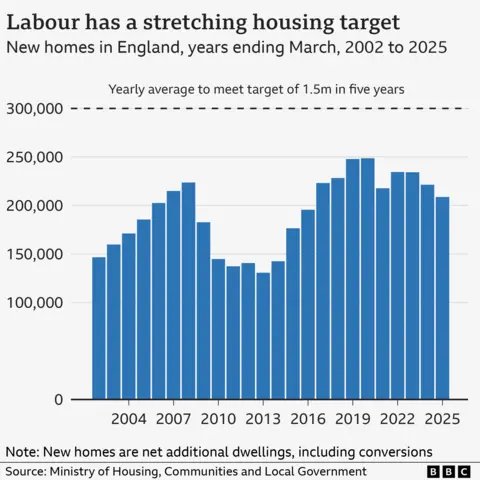
Starmer’s plan is to build 1.5 million “safe and decent homes” in England.
This is to be delivered by the end of this Parliament – so by 2029.
The government is measuring progress by looking at ‘net additional dwellings’ – the difference between houses and flats built or converted and those demolished.
No annual target has been set but getting this many homes would average out at 300,000 a year.
Labour is only currently managing to add just over 200,000 a year.
Ministers say they were always going to ramp up to the 1.5 million target in the later years of the Parliament.
However, it is worth noting that, so far, the delivery rate is actually down on the final years of the last Conservative government.

When will we know? Figures for the full year to the end of March come out in November.
But you can follow the progress, including in your area, on BBC Verify’s housebuilding tracker, which uses a more timely indicator: the number of new homes receiving their first Energy Performance Certificate (EPC). These figures come out roughly a month after the end of each quarter.
Hospital waiting lists
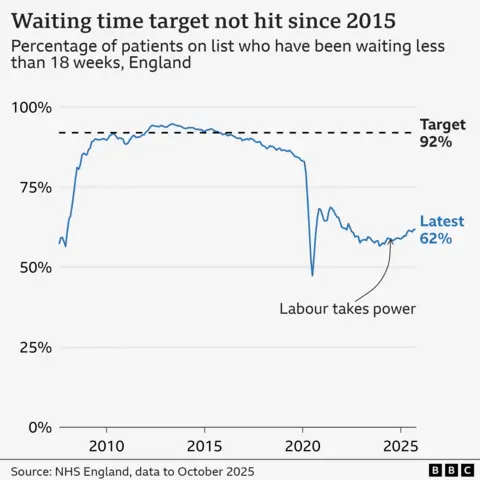
On health, the pledge is that 92% of patients in England will be seen within 18 weeks by the end of the Parliament.
There have been some signs of progress.
The latest NHS data for England show that in October 2025, 61.7% of patients due for procedures were seen within 18 weeks.
When Labour took power in July, the share was 58.8%.
But there is a long way to go and the last time the 92% target was hit was in 2015.
When will we know? Waiting list figures come out about six weeks after the end of a month.
Living Standards
Starmer’s plan commits to ‘raising living standards in every part of the United Kingdom’.
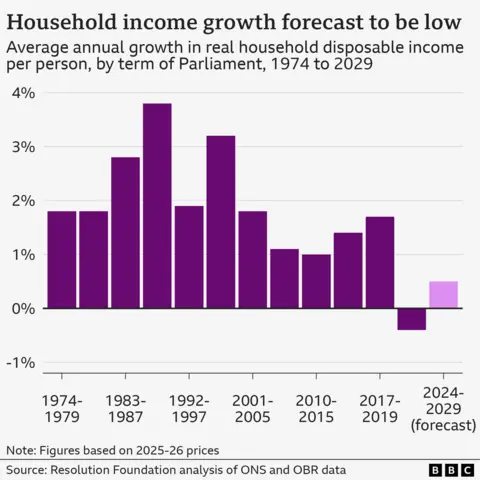
The government says ‘real household disposable income” (RHDI) per person – which roughly measures what is left after taxes and benefits and the effects of inflation – will grow over the Parliament.
The Office for Budget Responsibility (OBR), which does the government’s forecasts, predicts this measure will rise over the Parliament but only by 0.5% a year on average.
If that were delivered it would be the second weakest growth in a Parliament since the 1970s.
The worst since then was under the last Conservative government, when living standards fell.
Another measure of living standards which the government is using to track its target is GDP per head – the size of the economy divided by the population.
The OBR predicts that it will have risen by 1% in 2025.
When will we know? RHDI figures come out about three months after the end of each quarter of the year. GDP per capita figures are published about six weeks after the end of each quarter.
Crime
On crime, the pledge is “putting police back on the beat” with 13,000 additional officers, police community support officers (PCSOs) and volunteer special constables in neighbourhood policing roles in England and Wales by the end of the Parliament.
The Home Office has not given a breakdown of the 13,000 figure but has said it will “work with police forces on the mix of roles” and that it will “vary from force to force”.
According to the latest Home Office figures, there were 17,175 full time equivalent (FTE) police officers and PCSOs in neighbourhood policing roles in England and Wales as of 31 March 2025.
That was an increase of 214, or 1.3%, from 31 March 2024.
When will we know? The government says detailed figures on neighbourhood policing will be published in January 2026 and then updated every six months in March and September.
Education
 PA
PAThe pledge is to have “75% of five-year-olds in England ready to learn when they start school”.
The government defines this as having a “good level of development” in the Early Years Foundation Stage assessment, which is based on teachers’ assessments in areas such as language, personal, social and emotional development, and maths and literacy.
Official data from the Department for Education suggests that in the 2024-25 school year, 68.3% of children in England had a good level of development.
This was up slightly from 67.7% the previous year.
When will we know? The figures for the school year 2027-28 will come out in November 2028.
Clean power
Starmer’s plan promises “at least 95% clean power by 2030”.
This is slightly down on an election manifesto pledge to have “zero-carbon electricity by 2030”.
In November 2024, the National Energy System Operator (NESO) – the government’s independent system planner and operator for the energy transition – concluded that it was “possible to build, connect and operate a clean power system for Great Britain by 2030, while maintaining security of supply”.
However, it added that achieving this would be “at the limit of what is feasible”.
In 2024, clean sources accounted for 73.8% of electricity generation in Great Britain, according to government statistics and definitions.
When will we know? Figures for the proportion of UK-wide electricity coming from low carbon sources come in the Energy Trends publication on the last Thursday of each quarter of the year, giving figures for the previous quarter.
Additional reporting by Daniel Wainwright, William Dahlgreen, Mark Poynting, Gerry Georgieva and Tamara Kovacevic


Related Posts
Kemi Badenoch hopes to grab attention with policy blitz
The country's most successful political party, when it comes to…

Who is giving evidence on the collapsed China spy trial?
Jack FenwickPolitical correspondent ReutersSenior officials at the heart of the…
No financial support for Mossmorran plant
BBCThe UK government has said it will not offer financial…